



Introduction
Federation of Community Forestry Users Nepal (FECOFUN) and its implementation partners TRAFFIC; ANSAB (Asia Network for Sustainable Agriculture and Bioresources); FairWild Foundation; University of Copenhagen; University of Oxford; Tribhuvan University; Worldwide Fund for Nature India (WWF India), and collaborating partners Ministry of Forests and Environment, Nepal; Nepal Herbs and Herbal Products Association (NEHHPA); China Association of Traditional Chinese Medicine (CATCM); China Standard Conformity Assessment Co. Ltd. (CSCA); and Terra Himalaya Pvt. Ltd. is conducting a five years project Scaling Conservation of Himalayan Plants and Fungi through Sustainable Trade (2024 to 2029) in the 10 mountainous Himalayan districts of Nepal, focusing on conservation, sustainable harvesting and trade of highly important non-timber forest products (NTFPs).
Nepal’s alpine Himalayan forests and rangelands are globally significant biodiversity hotspots, home to key species including various plants and fungi. Over 40 important non-timber forest products (NTFPs) are harvested and traded internationally, significantly contributing to the incomes of the rural poor. Despite the positive impacts of Nepal’s pioneering community forestry approach, alpine wild plants, including NTFPs and fungi, face numerous threats such as overharvesting, climate change, illegal trade, fire, uncontrolled grazing, and inequitable supply chains, jeopardizing local livelihoods and biodiversity in the high Himalayas. This issue affects the entire region. There are significant opportunities to enhance the sustainability and trade of wild-harvested forest products by scaling up successful initiatives in Nepal and linking them to major markets like India and China.
Objectives:
This project aims to improve local livelihoods, elevate traditional knowledge, and strengthen national and regional approaches to sustainable biodiversity-based trade. At the impact level, the project will contribute to the sustainable management of Himalayan wild plants and fungi, with value chains that promote equitable trade, increase value addition, reduce poverty, and conserve species and ecologically fragile landscapes.
Project Location:
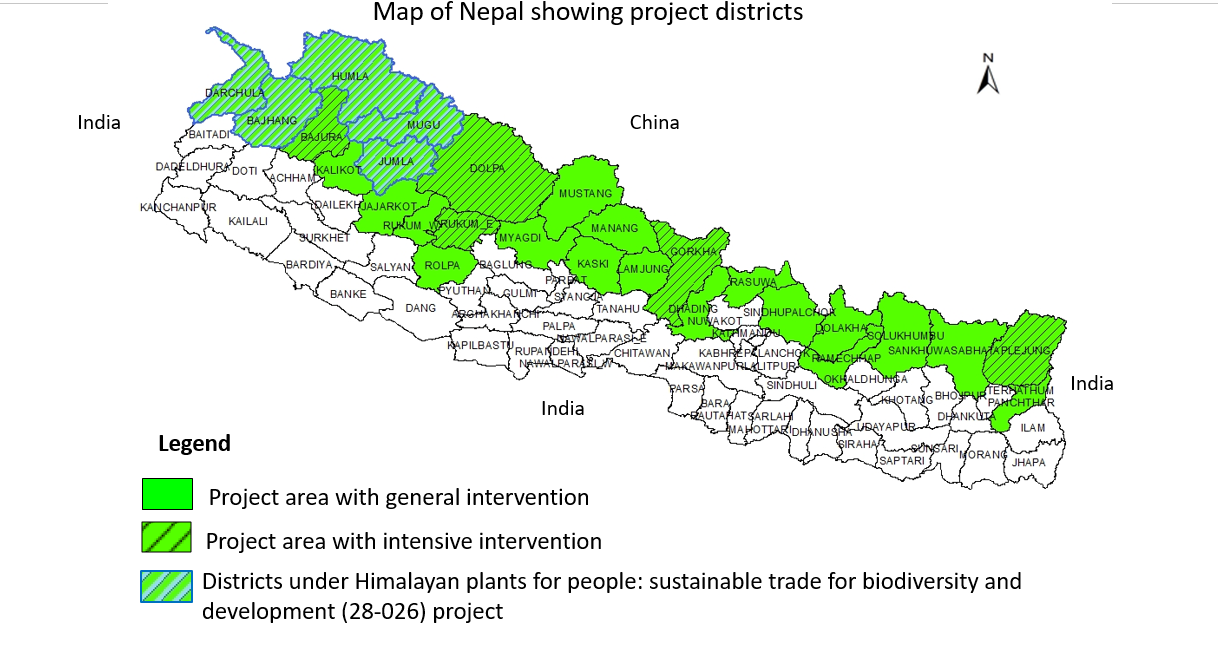
The project area covers the 10 mountainous Himalayan districts (Darchula, Bajhang, Bajura, Humla, Jumla, Mugu, Dolpa, Rukum East, Gorkha, and Taplejung).
Major Activities:
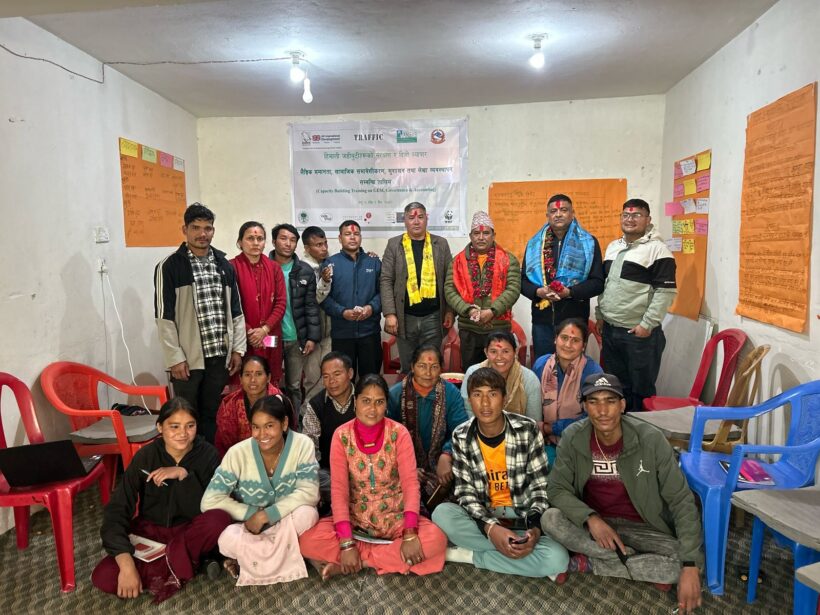
- Build capacity of Local Resource Persons (LRPs) including FECOFUN district chapters on GESI and governance, bookkeeping and accounting.
- Organize roll-out trainings to ~350 CFUGs on standards/sustainable forest management, and more focused trainings to 90 CFUGs to enable meeting certification requirements
- Build capacity of CFUG executive committees in all target districts on organizational governance, book-keeping and accounting, gender and social inclusion
- Enable for a sustainable livelihood management plan being discussed and adopted by respective line agencies (incl. DFOs), municipalities, district FECOFUNs, CFUGs and other CSOs
- Facilitate the roll-out of harvesters’ registration system by local FECOFUNs, including the expansion of harvesters and their households included in CFUGs.
- Organize policy dialogues on major issues and solutions for mountain forests at district and national levels – focusing on CFUGs and NTFPs
- Organize meetings/ AGM – as part of CFUG management plan revision
- Support CFUG for the implementation of management plan via mobilized LRPs
Outputs:
The project has overall five outputs: (i) Improved capacities and capabilities of stakeholders, especially women and excluded groups, for better conservation, resource management, and sustainable trade; (ii) Enhanced livelihoods for over 10,000 harvesters through long-term, sustainable, equitable trade in NTFPs; (iii) Sustainable management of over 110,000 hectares of high-altitude Himalayas through participatory land and species management and monitoring approaches; (iv) Establishment of sustainable Himalayan wild NTFP value chains from harvest to consumers based on traceable, certifiable production systems; and (v) Inclusion of provisions for sustainable, traceable trade in wild plants and fungi in the policies, trade agreements, and legal frameworks of Nepal, the region, and key importing countries.